Real Estate Agents: Add Mortgage Broking to Your Skillset

In today’s competitive property market, real estate professionals are constantly seeking ways to stand out and add value for their clients. One savvy approach gaining traction across Australia is for real estate agents to upskill in mortgage broking. This strategy not only sets you apart but opens up entirely new revenue streams and opportunities for deeper client engagement.


Why the Real Estate and Finance Connection Works

Real estate agents are already trusted advisors when it comes to property, but home buyers also need a trusted voice on finance. Mortgage brokers play a key role in securing the best loan options—something that 70% of Australian borrowers now rely on brokers for when arranging their home loan​. By acquiring mortgage broking qualifications, you can provide a more holistic, streamlined service for clients.

This integration makes sense because:

  • Clients want convenience: Buyers and sellers appreciate a seamless experience. By helping them navigate both property and finance, you eliminate the need for multiple third-party referrals.
  • Build strong client relationships: Being involved in both stages of the property transaction builds incredible trust and fosters lifelong customers.
  • Stand out in a crowded market: Many agents compete on commission rates, marketing packages, and property presentation. Adding mortgage solutions immediately positions you as a full-service professional.

Income Benefits and Stability

Property sales can be cyclical, but mortgage broking offers an income stream that provides stability during quiet periods. Brokers generally earn through upfront commissions from lenders and ongoing trail commissions for the life of the loan​​. This means that, even if property listings slow down, the financial services component can still deliver consistent revenue.

Some agencies have adopted collaborative models where agents work closely with brokers to capture this additional income. In certain setups, individual agents earn referral fees or a share of the broking revenue, which adds a healthy supplement to their usual commissions​​.


Regulatory and Ethical Considerations

It’s important to remember that you can’t perform both roles for the same transaction under one licence due to ethical and regulatory reasons, including privacy and conflict of interest laws​​. However, by setting up a separate broking entity or obtaining the necessary licences, this can be fully compliant. You’ll need to:

These steps ensure you maintain the highest professional standards while delivering exceptional service.


What This Means for Clients

Clients stand to gain enormously from this integrated service model. Instead of the stress of juggling multiple appointments and advisors, they can deal with one professional who understands their property goals and financial position. For first-home buyers especially, this can turn a complex, daunting process into an empowering experience.


Future-Proofing Your Career

The Australian mortgage broking industry continues to grow at a rapid rate, with brokers now writing the majority of home loans​​. Meanwhile, property markets move through cycles, and agents who diversify their skills are better placed to weather downturns. By adding mortgage broking to your toolkit, you future-proof your career, gain an additional stream of income, and provide unmatched value to your clients.


Key Takeaway

If you’re a real estate agent looking to elevate your service and income, mortgage broking is a natural fit. It combines relationship-driven roles, offers flexibility, and positions you as an all-in-one property and finance expert. With training, compliance, and the right approach, you’ll be ready to unlock the full potential of this complementary skill.


For details of the next course please call

1300 136 947 – 02 9922 5198

Book now to ensure your success as a Mortgage Broker

Related Articles:

How long does it take to complete a mortgage broker course?
How do I add Mortgage Broking to my Real Estate Office

How long does it take to complete a mortgage broker course?

How does mortgage broking work?

How does mortgage broking work?

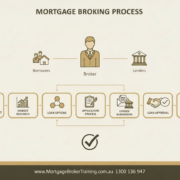
Mortgage broking involves acting as an intermediary between borrowers and lenders to find and secure mortgage deals. Here’s a simplified overview:

  1. Client Assessment: The broker assesses the client’s financial situation, goals, and borrowing needs.
  2. Market Research: The broker researches and compares various loan options from multiple lenders.
  3. Loan Options: The broker presents the client with suitable loan options, highlighting features, benefits, and costs.
  4. Application Process: The broker assists the client with the loan application, ensuring all necessary documentation is provided.
  5. Lender Submission: The broker submits the application to the chosen lender.
  6. Loan Approval: The lender assesses the application and approves or declines the loan.
  7. Settlement: If approved, the broker facilitates the loan settlement process.

Mortgage brokers should have access to a range of lenders and loan products, allowing them to shop around for the best deals for their clients. They can also help with paperwork, negotiations, and ensuring the loan meets the client’s needs.

In Australia, mortgage brokers are required to hold a credit license or work under someone who does. They must also adhere to responsible lending practices and provide clients with a Credit Guide and a Key Fact Sheet outlining the loan details.

Ready to Explore Your Options?

If you’re serious about getting started in mortgage or finance broking, we’re here to help.
Call  1300 136 947 for a confidential conversation to discover your options. We can discuss your background, assess your eligibility for RPL, and show you the fastest pathway to your Certificate IV (FNS40821) or Diploma in Finance and Mortgage Broking Management (FNS50322).

Is It Time to Grow and Move On From Your Job in the Bank to Become a Broker and Earn What You’re Worth?

Banking roles come with structure and stability, but they often cap your earning potential. If you’re watching your earning potential hit a ceiling while you’re making money for the bank, it might be time to think differently.
Mortgage broking offers something different: independence, flexibility, and the ability to build real wealth based on your effort and client relationships.
Here’s what many banking professionals don’t realize: your years of experience in banking may already qualify you to receive your mortgage broking qualification faster through Recognition of Prior Learning (RPL).

The Transition Isn’t Just About More Money—It’s About Control

As a broker, you decide your hours, your clients, and your income ceiling. There’s no corporate structure limiting your earning potential. No more watching commissions disappear into corporate pockets while you do the work.
This is the fundamental difference between employment and independence. In banking, your value is capped by your salary band. In broking, your value is directly tied to the relationships you build and the clients you serve.

Your Banking Experience Is Already Worth Something

This is where most career changers get it wrong. They think they need to start from scratch. They don’t.
If you’ve worked in banking—whether in lending, customer service, compliance, operations, or any finance-related role—that experience counts. Your knowledge of financial products, client relationships, regulatory requirements, and industry practices is directly transferable to mortgage broking.
Recognition of Prior Learning (RPL) means you can potentially receive your Certificate IV in Finance and Mortgage Broking (FNS40821) or Diploma in Finance and Mortgage Broking Management (FNS50322) based on the experience you already have. You don’t need to repeat learning you’ve already completed.

How Recognition of Prior Learning (RPL) Works

Rather than going through fundamentals you already understand, RPL assesses your existing knowledge and experience. If your banking background demonstrates competency in key areas, you can skip those modules and focus on the mortgage broking-specific skills and compliance requirements you actually need to learn.
This means:
  • Faster qualification – Complete your Certificate IV or Diploma quickly by showing your skills and experience
  • Cost efficiency – Pay only for the training you actually need
  • Career acceleration – Get into broking sooner and start earning sooner
  • Respect for your experience – Your years in banking aren’t wasted; they’re leveraged

The Right Training for Your Transition

What you do need is proper training in the areas specific to mortgage broking—compliance, client management, and the practical skills that matter in the real world. That’s exactly what our Certificate IV in Finance and Mortgage Broking (FNS40821) and Diploma in Finance and Mortgage Broking Management (FNS50322) deliver.
Our courses are taught by trainers with 20+ years of hands-on industry experience. They don’t teach theory in isolation; they teach you what actually works, what regulators expect, and how to build a sustainable broking business.
Both qualifications are nationally recognized and delivered in partnership with the National Finance Institute (RTO 31203).

Flexible Study Options

We understand that career changers have different needs. That’s why we offer multiple study formats:
  • Face-to-face workshops in major Australian cities
  • Online learning for flexibility and convenience
  • Distance education for those who prefer self-paced study
  • Full-time or part-time options to fit your schedule

Why Now?

The mortgage broking industry is growing. Demand for brokers is strong. And if you’ve been thinking about making the move, the timing has never been better.
Your banking experience is valuable. Your next chapter in mortgage broking starts with the right training and the right support—and RPL means you can get there now.

Ready to Explore Your Options?

If you’re serious about transitioning from banking to broking, we’re here to help. A confidential conversation can assess your experience and show you exactly how RPL could work for you.
Call  1300 136 947 for a confidential conversation to discover your options.
We’ll discuss your banking background, assess your eligibility for RPL, and show you the fastest pathway to your Certificate IV (FNS40821) or Diploma in Finance and Mortgage Broking Management (FNS50322).
Or visit www.mortgagebrokertraining.com.au/recognition-of-prior-learning/ to learn more about how RPL can accelerate your transition into mortgage broking.

How do I add Mortgage Broking to my Real Estate Office

Do I Need A credit Licence

Building a Network and Gaining Experience as a Mortgage Broker

Banker to Successful Mortgage Broker

What options do I have for Certificate IV Mortgage Courses

How to Get Recognition of Experience Cert 4 Mortgage Broking

certificate iv in finance and mortgage broking face-to-face